Simple Prayer Before Meal: Beautiful Words to Bless Your Food and Table
Introduction: Why a Simple Prayer Before Meal Still Matters
There is something quietly powerful about pausing before you eat. In a world that moves faster than most of us would like — where meals are consumed between meetings, in front of screens, or standing over a kitchen counter — the act of stopping, bowing your head, and offering a simple prayer before a meal is a form of deliberate grace that has survived millennia for good reason.
It is not complicated. It does not require theological training or a memorized liturgy. A simple prayer before meal can be a single sentence spoken from the heart, a traditional blessing passed down through generations, or a quiet, wordless moment of gratitude. What matters is the intention behind it: to acknowledge that the food on your table is a gift, and that the people gathered around it are a blessing too.
Across cultures and faith traditions — Christianity, Judaism, Islam, Hinduism, and beyond — the practice of blessing food before eating is one of the most universal spiritual habits in human history. Researchers studying the psychology of gratitude have found that practices like saying grace before meals are directly linked to increased feelings of thankfulness, connection, and even contentment. This is not just tradition for tradition’s sake. It is a small ritual with measurable impact on how we experience our lives.
Whether you are looking for words to teach your children, something to share at a family gathering, or simply a way to bring a moment of peace to your own daily table, this guide has you covered. We will explore the history, meaning, and practice of the simple prayer before meal — and offer you a wide range of beautiful, heartfelt options to use today.
The History and Meaning Behind Blessing Food
The tradition of offering a simple prayer before a meal is as old as organized human community itself. Ancient cultures from Greece and Rome to the indigenous peoples of every continent developed rituals around food that combined practical gratitude with spiritual awareness. They understood something that modern psychology is only now quantifying: that mindful acknowledgment of abundance changes the way we receive it.
In the Jewish tradition, the Hamotzi — a blessing over bread — has been spoken before meals for thousands of years, thanking God for bringing forth bread from the earth. In Christianity, the practice of saying grace traces directly to the accounts of Jesus blessing and breaking bread at the Last Supper, and it has remained central to Christian family life across denominations ever since. In Islam, saying Bismillah (“In the name of God”) before eating is a Sunnah — a recommended practice of the Prophet Muhammad — that transforms the everyday act of eating into an act of worship.
What is remarkable is how consistent the impulse is across traditions that otherwise differ enormously in theology and practice. The simple prayer before meal is not a denominational quirk — it is a human instinct. We recognize, in our better moments, that food is not something we produce entirely by our own effort. Rain falls, seeds grow, hands harvest and prepare and cook. There is grace already woven into the process. The prayer simply names it.
Why Saying Grace Matters for Families and Children
If you grew up in a household where a simple prayer before meal was part of daily life, you likely remember it clearly — even if you cannot remember many other things from the dinner table of your childhood. That staying power is meaningful. Rituals that are repeated with intention become anchors in a child’s inner world.
Child development research consistently shows that children benefit from predictable routines that carry positive emotional associations. A short blessing before eating — one that is gentle, warm, and repeated daily — becomes exactly that kind of anchor. It teaches children that gratitude is not just a feeling but a practice. It models the habit of pausing before consuming. And it gives families a shared language of appreciation that transcends the particular food on the plate.
A simple prayer before meal does not need to be elaborate to leave a lasting impression on a child. Even a four-line rhyming grace, repeated at every dinner for years, can become one of the most vivid and comforting memories a person carries into adulthood. The simplicity is not a limitation — it is the point.
Simple Prayers Before a Meal for Christian Families
For families rooted in the Christian tradition, a simple prayer before meal is an expression of faith in a God who provides. These prayers do not need to be long or formal. The most enduring ones are the briefest, because brevity breeds consistency, and consistency is where genuine spiritual practice lives.
A Classic Traditional Grace
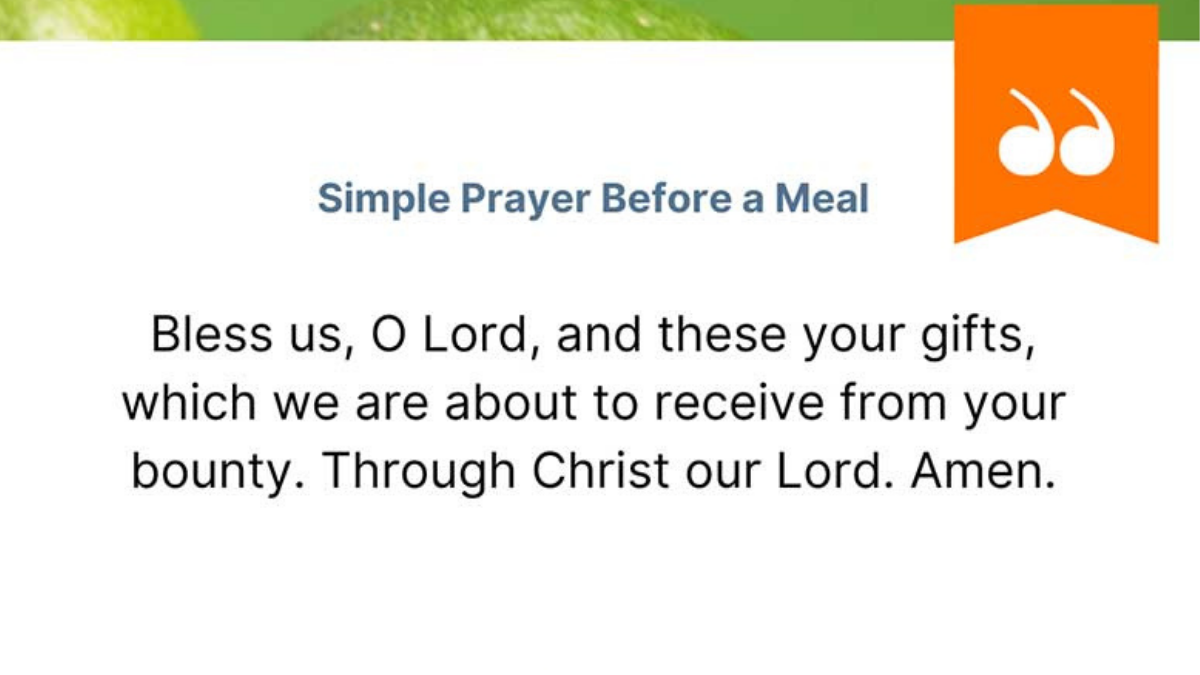
“Bless us, O Lord, and these Thy gifts, which we are about to receive from Thy bounty, through Christ our Lord. Amen.”
This is one of the most widely known Christian meal prayers in the English-speaking world. It is short, reverent, and deeply traditional — a simple prayer before meal that has been spoken at Catholic tables for centuries and remains entirely at home in modern family life.
A Gentle Prayer for All Ages
“Thank You, Lord, for this food we share. Thank You for the hands that prepared it, the love that surrounds this table, and Your constant care. Amen.”
This prayer works beautifully for families with children because it is warm rather than formal, and it draws attention to both the food and the people — a reminder that the meal is about more than what is on the plate.
A Short and Simple Blessing
“Lord, thank You for this food. Bless it to our bodies and our bodies to Your service. Amen.”
Sometimes the best simple prayer before meal is the one that takes ten seconds and means every word. This blessing is perfect for busy weeknight dinners or any moment when brevity matters more than length.
Simple Mealtime Prayers for Children
Children thrive with prayer that is accessible, rhythmic, and joyful. A simple prayer before meal designed for young children should be easy to memorize, light in tone, and ideally something they can eventually lead themselves — because there is no better way to build a spiritual habit in a child than to give them ownership of it.
A Classic Children’s Grace
“God is great, God is good. Let us thank Him for our food. By His hands we all are fed. Thank You, Lord, for daily bread. Amen.”
This is perhaps the most recognized children’s mealtime prayer in the Christian tradition. Its rhyming structure makes it memorable for even the youngest children, and its sentiment — gratitude for provision — is as simple and true as anything in spiritual life.
A Modern Rhyming Prayer for Little Ones
“Thank You for the world so sweet. Thank You for the food we eat. Thank You for the birds that sing. Thank You, God, for everything. Amen.”
This prayer, often attributed to Edith Rutter Leatham, is gentle and wide in its gratitude — it places the meal within a larger sense of wonder about the world. Children who pray this regularly develop a natural orientation toward thankfulness that extends well beyond the dinner table.
A Simple Blessing Children Can Learn Quickly
“Bless this food, bless this day. Thank You, God, for all we pray. Amen.”
Sometimes a simple prayer before meal for children just needs to be short enough to hold their attention and meaningful enough to form a habit. This two-line blessing does exactly that.
Interfaith and Non-Denominational Meal Blessings
Not every family comes to the table with a shared religious framework, and that should not prevent anyone from experiencing the warmth and intentionality of a mealtime blessing. The simple prayer before meal can be beautifully non-denominational — rooted in gratitude rather than doctrine, and therefore accessible to people of all backgrounds.
A Universal Gratitude Blessing
“We are grateful for this food, for the hands that grew and prepared it, for the table we share, and for the love that surrounds us. May this meal nourish our bodies and our spirits. Amen.”
This blessing mentions no deity by name and makes no theological claims. It is simply a moment of conscious, communal gratitude — and that is enough. Many families who practice no formal religion still find that a blessing like this transforms the experience of eating together.
A Nature-Centered Meal Prayer
“We give thanks to the earth that grew this food, the sun and rain that fed it, the hands that harvested and prepared it, and the company that shares it with us. May we eat with awareness and gratitude. Amen.”
This Earth-centered blessing is particularly resonant for families who draw their sense of the sacred from the natural world. It grounds the simple prayer before meal in the actual chain of events that brought the food to the table — a deeply mindful perspective.
A Moment of Silence
It is worth noting that a simple prayer before meal does not need to be verbal at all. In Quaker tradition, for instance, a moment of shared silence before eating carries the same weight as spoken words. Families who include members of different beliefs — or no formal belief — sometimes find that thirty seconds of quiet togetherness before a meal creates exactly the space and intention that a blessing is meant to create.
How to Make Mealtime Prayer a Daily Habit
Knowing a simple prayer before meal is one thing. Turning it into a consistent daily practice is another — and it is here that many well-meaning families run into difficulty. Life is busy. Dinner time is often chaotic. The temptation to skip the blessing just this once becomes a pattern that erodes the habit entirely.
The key is to keep the prayer simple enough that there is no reason not to say it. If the grace requires reading from a card, finding a book, or remembering a long liturgy, it will be skipped on the hard days. But if a simple prayer before meal is short enough to say from memory in ten seconds, the bar for participation drops to nearly zero — and the habit survives.
Some families rotate the responsibility of leading grace so that every person at the table — children included — has ownership of the practice. Others always let the youngest child lead, which keeps the tradition anchored in accessibility and warmth. Some families write their own original prayers together, which creates a shared language that is deeply personal to their household.
The form matters far less than the frequency. A simple, consistent mealtime blessing — said every day without exception — builds something that elaborate, occasional prayers cannot: a living tradition.
Why This Matters: The Deeper Purpose of Food Blessings
A simple prayer before meal does more than acknowledge the food. At its best, it reorients the people at the table. It pulls their attention away from wherever their minds were — the stress of the day, the notifications on their phones, the argument they had in the car on the way home — and places it, for just a moment, on what is actually present: the food, the people, and the quiet miracle of being fed.
Research published in the journal Psychological Science has shown that expressing gratitude before receiving something — a meal, a gift, a piece of good news — significantly increases the enjoyment of that thing. The simple prayer before meal is, among other things, a neurological reset. It changes how we receive what we are about to eat.
Beyond the individual benefit, there is something profoundly communal about the mealtime blessing. It is one of the few moments in family life where everyone at the table does the same thing at the same time, with the same orientation. In a household where family members scatter in different directions for most of the day, that thirty-second alignment around shared gratitude is more valuable than it might appear.
Expert Recommendations: Making the Most of Your Mealtime Blessing
If you are establishing or re-establishing a practice of saying a simple prayer before meal in your home, here are some reflections that can help.
Start with what you already know. If you grew up with a specific grace and it still resonates with you, use it. The familiarity is itself part of the value. If you are starting fresh, choose one short prayer and use it consistently for thirty days before adding variety.
Involve everyone at the table. The simple prayer before meal has the most impact when it is shared rather than performed. Even young children can hold hands, bow their heads, or add their own word of thanks after the main prayer.
Do not overthink it. The grace that gets said imperfectly every day is more spiritually alive than the perfect prayer that never quite makes it to the table. Simplicity and consistency are the two qualities that matter most.
Conclusion: Finding Your Simple Prayer Before Meal
There is no wrong version of a simple prayer before meal. Whether it is a centuries-old traditional blessing, a two-line rhyme your child can recite, a universal gratitude statement that transcends any single tradition, or a quiet moment of shared silence — what matters is that you stop, together, and acknowledge what you have been given.
The simple prayer before meal is one of the smallest spiritual practices available to human beings. It takes ten seconds. It requires no equipment, no preparation, and no expertise. And yet practiced consistently, it can change the entire texture of a family’s relationship to food, to gratitude, and to each other.
Start tonight. Choose one of the blessings in this guide, or write your own in plain language that means something to you. Say it before dinner. Say it again tomorrow. Let it become the rhythm your table lives by — a simple, daily act of grace that reminds everyone present that even an ordinary meal is worth being thankful for.
Frequently Asked Questions
Q1. What is a simple prayer before a meal? A simple prayer before a meal — also called saying grace or a mealtime blessing — is a short expression of gratitude spoken before eating. It can be rooted in a specific religious tradition or be entirely non-denominational. Its purpose is to pause before eating, acknowledge the gift of food, and bring a sense of mindfulness and gratitude to the table. Even a single sentence spoken sincerely qualifies as a genuine mealtime prayer.
Q2. What is the most common traditional prayer before eating? One of the most widely known traditional prayers before eating in the English-speaking Christian world is: “Bless us, O Lord, and these Thy gifts, which we are about to receive from Thy bounty, through Christ our Lord. Amen.” Another extremely common one is the children’s grace: “God is great, God is good. Let us thank Him for our food.” Both have been used for generations and remain in widespread use today.
Q3. How do you teach children to say grace before meals? The most effective approach is to start with a very short, rhyming prayer that children can memorize easily — such as the classic “God is great, God is good” blessing. Repeat it at every meal without exception so it becomes a natural part of the routine. As children grow, invite them to lead the prayer themselves, and gradually introduce longer or more personally meaningful versions. Consistency matters far more than complexity.
Q4. Can a meal prayer be non-religious? Absolutely. A simple prayer before meal does not need to reference God or any religious figure to be meaningful and spiritually valuable. Many families use gratitude-centered blessings that thank the earth, the farmers, the people who prepared the food, and those gathered at the table — without any specific theological content. The core of a mealtime blessing is intentional gratitude, which is a deeply human experience regardless of faith background.
Q5. Why is it important to pray or say grace before eating? Saying a simple prayer before meal serves several meaningful purposes. Spiritually, it acknowledges that food is a gift rather than something taken for granted. Psychologically, research shows that expressing gratitude before receiving something increases appreciation and enjoyment. Socially, it creates a moment of shared ritual that strengthens family bonds and builds lasting traditions. And practically, it trains both adults and children in the habit of mindfulness — the ability to pause, be present, and recognize what is good in ordinary moments.