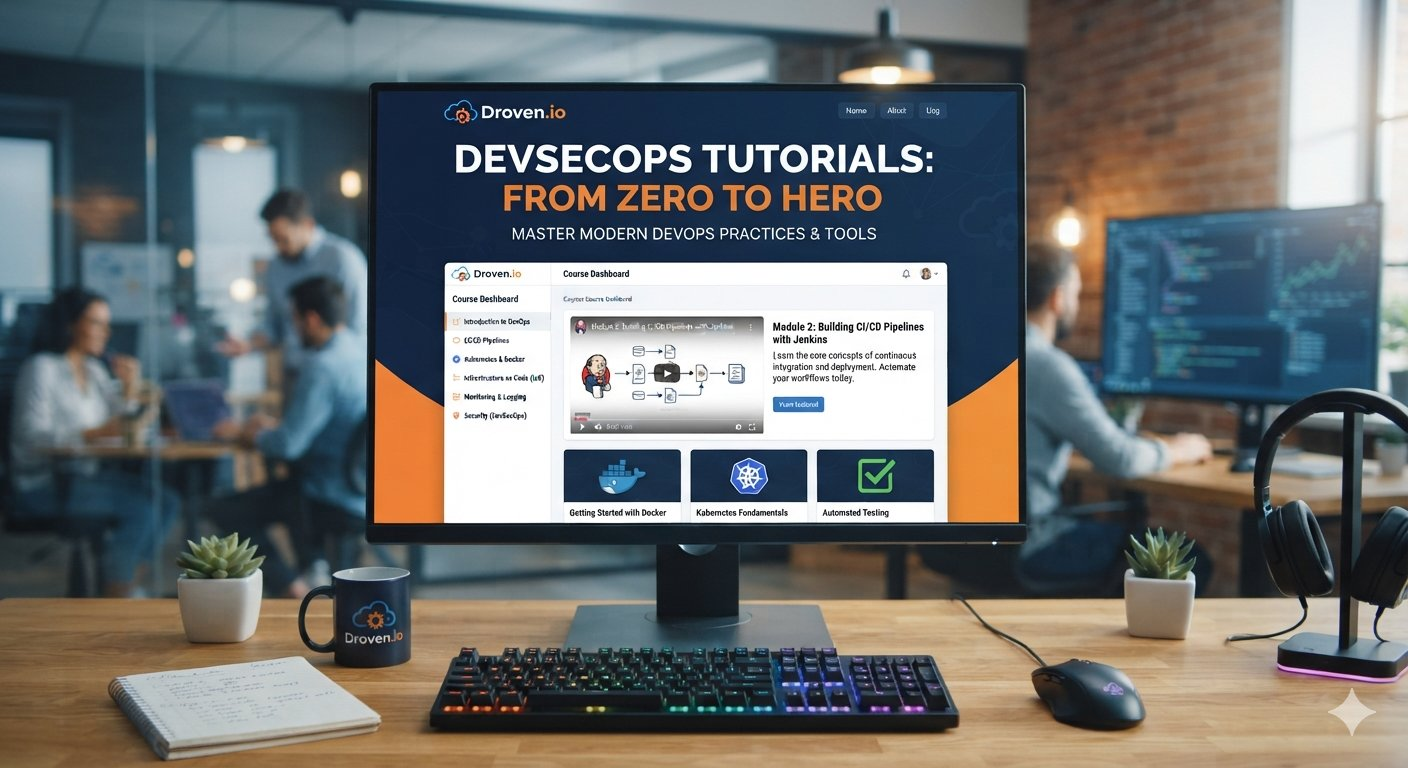
Droven io DevOps tutorials are gaining attention among developers, IT professionals, and beginners who want to understand modern software delivery, automation, containers, cloud infrastructure, and continuous deployment. The central idea behind DevOps is not simply learning a collection of tools; it is understanding how code moves from development to production through a repeatable and reliable workflow.
The official Droven.io site currently presents DevOps and system administration alongside cloud computing, cybersecurity, and other technology topics. Current material associated with io also highlights technologies such as Docker, Kubernetes, Terraform, Jenkins, and GitHub Actions.
For beginners, the challenge is knowing where to start. A good learning path connects individual technologies to the larger software-delivery process.
What Are Droven io DevOps Tutorials?
Droven io DevOps tutorials refer to educational material focused on DevOps concepts, tools, automation, and infrastructure practices associated with Droven.io. The subject covers the complete lifecycle of software, from source-code management and testing through deployment, monitoring, security, and ongoing maintenance.
DevOps brings development and operations closer together. Instead of developers finishing an application and handing it to a separate operations team, modern workflows encourage shared responsibility and automation throughout the lifecycle.
This distinction is important. Someone studying droven io DevOps tutorials should focus on why a technology is used rather than simply memorizing commands.
For example, Docker is not valuable merely because it is a popular tool. Its importance comes from helping teams package applications consistently. Likewise, CI/CD is valuable because it makes software testing and delivery more repeatable.
Why DevOps Skills Matter
Modern applications are updated frequently. Teams need reliable ways to test changes, deploy them, identify failures, and recover quickly when something goes wrong.
This is where DevOps practices become valuable. Automated pipelines can reduce repetitive manual work, while infrastructure as code can make environments more consistent and easier to reproduce.
The broader Droven.io technology content places DevOps alongside areas such as IT infrastructure, cloud computing, cybersecurity, and software development.That reflects how closely these disciplines now interact.
For someone following droven io DevOps tutorials, the goal should therefore be broader than learning one job-specific tool. Understanding the relationships between development, infrastructure, automation, security, and monitoring provides a much stronger foundation.
Start With Linux, Git, and Networking
www.geeksforgeeks.org/devops/devopswww.geeksforgeeks.org/devops/devopsBeginners sometimes jump directly into Kubernetes because it is one of the most visible DevOps technologies. That can make learning unnecessarily difficult.
A stronger foundation starts with Linux command-line skills, basic networking, Git, and simple scripting. These concepts appear repeatedly when managing servers, containers, pipelines, and cloud environments.
Git is particularly important because it provides the version-control foundation for many CI/CD workflows. A developer pushes a change to a repository, an automated system detects the change, tests are executed, and the application can then be packaged or deployed.
When working through , understanding this sequence is more useful than memorizing individual Git commands.
Learning CI/CD With Droven io DevOps Tutorials
Continuous integration and continuous delivery are central subjects in most modern DevOps learning paths.
A simple CI/CD workflow might begin when a developer pushes code to a Git repository. Automated checks can then install dependencies, run tests, build the application, scan for problems, and prepare it for deployment.
The important part is to build the process gradually.
Start with a simple application and configure a pipeline that runs a test whenever code changes. Once that works, introduce a build step. Afterward, add deployment to a safe testing environment.
This approach makes droven io DevOps tutorials more practical because every pipeline component has a visible purpose.
A useful exercise is deliberately breaking a test or changing a configuration value. Learning how to investigate a failed pipeline is often more valuable than seeing a successful pipeline run once.
Docker and Containerization
Docker is another major topic associated with . The official related material currently describes Docker as part of its DevOps learning roadmap, alongside Kubernetes and CI/CD.
A container packages an application and the components required for it to run in a consistent environment. This can reduce the differences between development, testing, and production systems.
Beginners should understand the difference between an image and a container. An image is a packaged template, while a container is a running instance of that image.
Learning to write a Dockerfile, build an image, run a container, expose ports, manage environment variables, and inspect logs provides a practical foundation.
Once Docker makes sense, Kubernetes becomes easier to understand because you can see why teams need orchestration when applications contain many containers.
Kubernetes and Container Orchestration
Kubernetes manages containerized workloads across infrastructure. It can handle deployment, scaling, service discovery, and other operational tasks.
Droven io DevOps tutorials can be approached more effectively by learning Kubernetes after understanding containers rather than treating Kubernetes as a standalone technology.
Start with fundamental concepts such as pods, deployments, services, namespaces, and configuration. A small local Kubernetes environment can provide a useful practice space before working with production clusters.
The goal is not to memorize every Kubernetes object. Instead, understand how an application is packaged, deployed, exposed, updated, and monitored.
That mental model makes more advanced Kubernetes configuration considerably easier.
Infrastructure as Code With Terraform
Infrastructure as Code, often abbreviated IaC, is another important DevOps practice. Instead of manually configuring every server or cloud resource, infrastructure can be described through version-controlled configuration.
Terraform is commonly used for this purpose and is included among technologies highlighted in current descriptions of
IaC can improve consistency and make infrastructure changes easier to review. A configuration change can be committed to version control, reviewed by another engineer, and applied through an established workflow.
However, Infrastructure as Code is not automatically safe. Credentials, state management, permissions, configuration errors, and destructive changes all require careful handling.
Learning these operational considerations is just as important as learning Terraform syntax.
Monitoring, Logging, and Observability
After an application reaches production, teams need to know whether it is healthy. Monitoring can reveal increasing latency, high resource consumption, failed requests, unavailable services, or repeated container restarts.
Droven io DevOps tutorials are most useful when monitoring is understood as part of the complete lifecycle rather than as a separate technology category.
Metrics provide numerical information about system behavior. Logs record events and application activity. Distributed traces can help engineers understand how a request travels through multiple services.
Tools such as Prometheus and Grafana are frequently associated with modern monitoring workflows, but the underlying concepts matter more than the specific product.
DevSecOps and Security Automation
Security should not be added only after an application has been deployed.
DevSecOps integrates security throughout development and operations. A pipeline can include dependency checks, static analysis, secret detection, container scanning, and infrastructure security checks.
This is an important part of droven io DevOps tutorials because automation without security can simply make insecure processes faster.
One basic rule should always be followed: never place passwords, private keys, API credentials, or cloud secrets directly into source-code repositories.
Least-privilege access, secure secret storage, dependency management, and audit logging should become routine parts of the workflow.
How to Learn From DevOps Tutorials Effectively
The biggest mistake beginners make is consuming tutorials without building anything.
When following , create a small project and move it through a complete workflow. A simple web application is enough.
Store the source code in Git, create automated tests, build a Docker image, run the application in a container, create a basic CI/CD pipeline, deploy it to a test environment, and add monitoring.
You do not need a complicated production architecture.
The value comes from seeing how each stage connects to the next and learning what happens when something fails.
Current third-party discussions of the Droven.io DevOps material similarly emphasize practical workflows rather than learning isolated commands.
Common Mistakes When Learning DevOps
Trying to master every DevOps technology simultaneously is a common mistake. Kubernetes, Terraform, Docker, cloud platforms, Jenkins, GitHub Actions, Linux, monitoring, and security are each substantial subjects.
Another mistake is focusing exclusively on tools. DevOps is a methodology and workflow, not a list of product names.
Copying configuration files without understanding them can also create problems. When an environment changes, copied configuration may stop working, leaving the learner unsure how to troubleshoot it.
Finally, do not underestimate troubleshooting. Real DevOps work involves investigating failed deployments, broken containers, unavailable services, configuration mistakes, resource limitations, and unexpected application behavior.
Frequently Asked Questions
What are droven io DevOps tutorials?
refer to learning material covering DevOps practices, automation, infrastructure, software delivery, containers, cloud technologies, and related engineering workflows.
Is Droven io suitable for DevOps beginners?
The material can serve as a starting point, but beginners should first develop basic Linux, Git, networking, and scripting knowledge before tackling advanced infrastructure topics.
What should I learn first in DevOps?
Start with Linux, Git, networking fundamentals, and basic scripting. Then progress toward CI/CD, Docker, cloud platforms, Infrastructure as Code, Kubernetes, monitoring, and security.
Do I need to learn Kubernetes immediately?
Yes. The most effective approach is to use tutorials as a guide while building your own application, pipeline, container environment, and deployment workflow.
Conclusion
can provide a useful starting point for understanding the technologies and practices behind modern software delivery. The strongest learning strategy, however, is not to chase every tool at once.
Build a foundation with Linux, Git, networking, and scripting. Then learn CI/CD, containers, cloud infrastructure, Infrastructure as Code, orchestration, monitoring, and security as connected parts of one workflow.
The official Droven.io technology categories currently include DevOps and system administration, cloud computing, cybersecurity, and software-development topics, giving learners related areas to explore as their skills grow.
Ultimately, the real value of io DevOps tutorials comes from applying what you learn. Build small projects, automate repetitive tasks, intentionally troubleshoot failures, and document what you discover. That approach turns DevOps from a collection of unfamiliar technologies into a practical engineering skill.
Suggested internal links: /devops-beginners-guide, /docker-tutorial, /ci-cd-guide, /kubernetes-basics, /terraform-tutorial
Would you like the next article to focus on Docker, Kubernetes, or CI/CD pipelines?
dailymagzcom