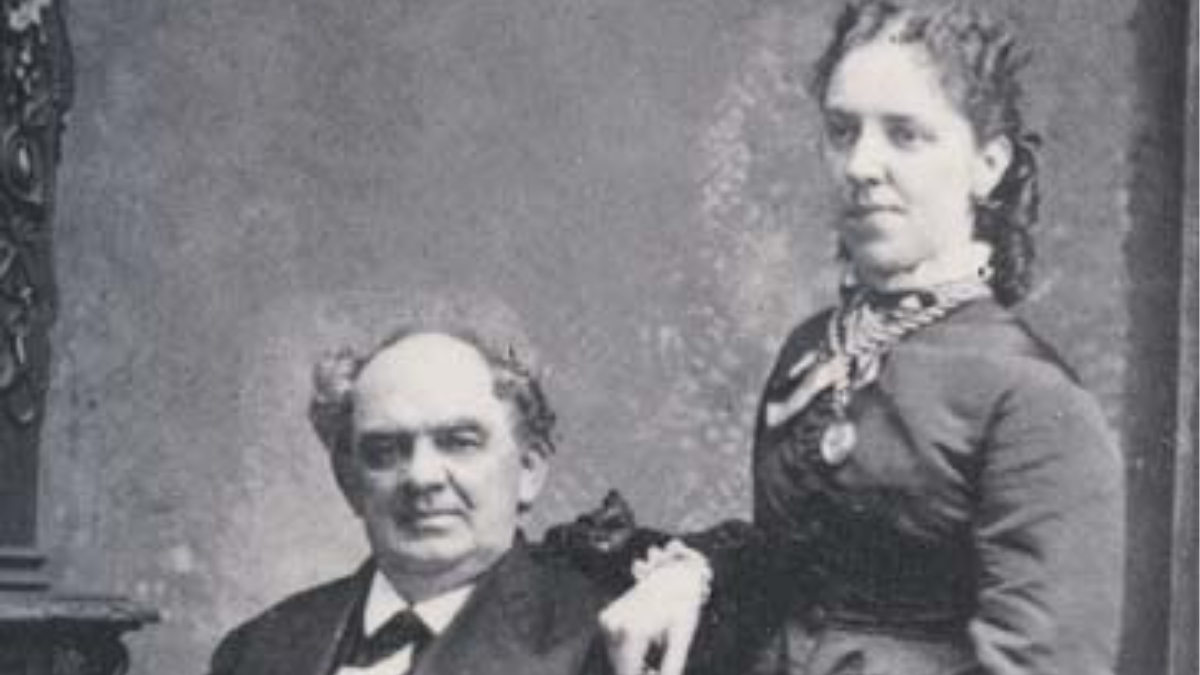
Charity Hallett — The Woman Who Chose Barnum Before the World Knew His Name
History has always had a complicated relationship with the women who stand behind extraordinary men. Their contributions are real, their sacrifices are significant, and their stories are too often compressed into a single supporting sentence in someone else’s biography. Charity Hallett is one such woman — and she deserves far more than a footnote. Born in 1808 in Bethel, Connecticut, she grew up to become the first wife of Phineas Taylor Barnum, the man the world would come to know as the greatest showman who ever lived. But long before Barnum was famous, before the circus existed, before the crowds gathered and the lights blazed, there was Charity Hallett — choosing him when he was nothing but potential and promise.
Understanding Charity Hallett means understanding what it meant to be a woman in early 19th-century America — navigating a world that offered women little agency, few professional options, and almost no public recognition — and choosing, within those constraints, to live with remarkable steadiness, loyalty, and grace.
Early Life of Charity Hallett — A Connecticut Upbringing
Charity Hallett was born on October 28, 1808, to Benjamin Wright Hallett and Hannah Sturges Hallett, a modest family in Bethel, Connecticut. Life in a small New England town in the early 1800s was shaped by community, church, and hard work. There were no grand ambitions on offer for young women — the world expected domestic virtue, not personal distinction. Yet the values instilled in Charity Hallett during those formative years — patience, diligence, and moral steadiness — would prove to be some of the most important forces in the Barnum household for the next four decades.
Before marriage, Charity worked as a tailoress and seamstress, stitching and repairing garments by hand in a trade that demanded both precision and endurance. This was honest, skilled labor — not glamorous, but deeply dignified. It was the work of a woman who understood that value is built quietly, stitch by stitch, day by day. That same philosophy would define her entire life alongside one of the most dramatic personalities American entertainment has ever produced.
Growing Up in Bethel — The World That Shaped Her
Bethel, Connecticut was not a large town, and its social world was close-knit. It was here that a young Phineas Taylor Barnum first encountered Charity Hallett. Barnum was born in Bethel too, though five years after Charity, in 1810. Their paths crossed in a community where everyone knew everyone, where reputations were earned slowly and respect was given to those who deserved it. By all accounts, Charity Hallett was precisely that kind of person — known for her warmth, her reliability, and a quiet confidence that attracted genuine admiration rather than fleeting attention.
The Courtship — Choosing Each Other Before the World Took Notice
What makes the love story of Charity Hallett and P.T. Barnum remarkable is its timing. Charity did not fall in love with a famous man. She fell in love with an ambitious, energetic, and somewhat impulsive young man who had very little to his name but a great deal of determination. In the summer of 1829, Barnum formally asked Charity Hallett for her hand in marriage. She accepted — and in doing so, she accepted not just a husband, but an entirely unpredictable life ahead.
Their wedding took place on November 8, 1829, in New York City, officiated by the Reverend Dr. McAuley, in the presence of relatives and close friends. Charity had traveled to New York ostensibly to visit her uncle, Nathan Beers, on Allen Street — a quiet, careful arrangement that speaks to the couple’s thoughtful approach even in their most romantic moment. Barnum later wrote in his autobiography, Struggles and Triumphs, that on that evening he became “the husband of one of the best women in the world.” It is a line that has aged beautifully because it rings true.
What Their Early Years Together Looked Like
The newlyweds returned to Bethel after the wedding, taking board in the same family home where Charity Hallett had previously lived. Those early years were modest by any standard. Barnum was still finding his footing professionally, moving between ventures — a lottery company, a general store, a newspaper — before the entertainment world revealed itself as his true calling. Through each of these iterations, Charity remained constant: managing the household, supporting the family, and providing the stable emotional ground from which Barnum could take his extraordinary risks.
Marriage, Motherhood, and the Making of an Empire
The marriage of Charity Hallett and P.T. Barnum lasted 44 years — a remarkable span that weathered enormous turbulence. Together they had four daughters: Caroline Cornelia, Helen Maria, Frances Irene, and Pauline Taylor. Tragically, Frances died before reaching her second birthday, a grief that Charity Hallett bore with the same quiet strength that characterized every aspect of her life.
As Barnum’s ambitions grew — from managing the American Museum in New York to launching the touring circus that would eventually become the legendary Barnum & Bailey Circus — Charity Hallett anchored the family at home. This was not a passive role. Managing a household in the 19th century was an enterprise in itself, particularly when that household was connected to a man whose public profile invited constant scrutiny, financial volatility, and social upheaval. Barnum was as capable of spectacular failure as he was of spectacular success, and Charity Hallett navigated both extremes with equanimity.
The Financial Storms She Weathered
Barnum’s financial life was a series of dramatic highs and crushing lows. He faced bankruptcy, legal battles, and public embarrassments that would have broken many marriages. Through each crisis, Charity Hallett stood firm — not with blind acceptance, but with the grounded resilience of a woman who understood that character is revealed in difficulty, not triumph. Historical accounts consistently portray her as a stabilizing presence in the Barnum household, someone whose calm demeanor balanced her husband’s perpetual showmanship and speculative nature.
This dynamic — the steady, private partner supporting the flamboyant public figure — is one that history has repeated many times. But Charity Hallett’s version of this role was notable for its duration, its consistency, and the genuine respect it earned from those who knew the couple personally. She was not simply enduring her circumstances; she was actively shaping them.
Charity Hallett in Popular Culture — The Greatest Showman
For many people today, Charity Hallett is most immediately recognizable through the 2017 musical film The Greatest Showman, in which she was portrayed by actress Michelle Williams. The film is an affectionate, heavily fictionalized account of Barnum’s life and career, and while it takes significant creative liberties with historical fact, it does capture something emotionally true about the Charity-Barnum dynamic: the depth of her loyalty, the steadiness of her love, and the contrast between her grounded nature and Barnum’s restless ambition.
Williams’ portrayal brought Charity Hallett to a new generation of viewers, many of whom then sought out the historical record behind the musical narrative. That curiosity is entirely warranted — the real Charity is, in many ways, more compelling than her cinematic counterpart. She lived through an era of enormous social change, raised a family through genuine hardship, and maintained a marriage that Barnum himself described with profound tenderness in his writings. The film’s Charity is a plot device; the historical Charity Hallett was a fully realized human being whose choices shaped one of the most remarkable stories in American cultural history.
The Final Years and the Legacy of Charity Hallett
By the early 1870s, Charity Hallett’s health had begun to decline. She passed away on November 19, 1873, at the family’s residence at 425 Fifth Avenue in New York City, at the age of 65. Barnum was abroad in Hamburg, Germany, at the time of her death, and the news reached him by telegram. He arranged for her remains to be embalmed and returned to Bridgeport, Connecticut, where a funeral service at the family home, Waldemere, drew many of the city’s most prominent citizens alongside family, friends, and clergy.
The Bridgeport Standard’s account of her funeral described a house filled with those who came to pay their respects to a woman deeply loved by her community. Charity Hallett was not famous in the way her husband was famous. She had not performed on a stage or marketed herself to the world. But she had earned something arguably more durable: the genuine affection and respect of the people who actually knew her.
After her death, Barnum eventually remarried — Nancy Fish, an English socialite some 40 years his junior — but he never appeared to diminish the significance of his first marriage. In his autobiography, the passages concerning Charity Hallett carry a warmth and reverence that make clear she was far more than a biographical detail to him. She was the foundation.
What Charity Hallett’s Story Teaches Us Today
The story of Charity Hallett resonates in 2026 not as a relic of a more constrained era for women, but as a reminder that influence takes many forms. Not all legacies are built from public achievement. Some are built from the daily, unglamorous, profoundly important work of holding things together — of being the person others can count on when the world gets loud and unpredictable.
Charity Hallett lived in an era when women had almost no formal power. She could not vote, could not own property independently in most circumstances, and could not pursue a career beyond the narrow options available to women of her class and time. Within those constraints, she built a life of genuine significance — as a partner, as a mother, as a community member, and as the quiet architect of a household from which one of America’s most famous careers was launched and sustained.
Her story invites us to look more carefully at the people behind the celebrated figures of history — to ask whose labor, whose patience, and whose loyalty made the spotlight possible for those we remember. When we ask that question about P.T. Barnum, the answer always begins with Charity Hallett.
Conclusion — Remembering Charity Hallett on Her Own Terms
History owes Charity Hallett a more complete account than it has typically provided. She was not a background character in someone else’s story — she was a protagonist in her own right, navigating the complexities of marriage, motherhood, financial uncertainty, and social expectation across four of the most transformative decades in American history. She chose Barnum before success chose him, and she stood by that choice through every season of their extraordinary shared life.
To know Charity Hallett is to understand that the quietest voices often carry the heaviest weight. She never sought fame, never courted public attention, and never asked the world to notice her contributions. But she made those contributions anyway — steadily, lovingly, and with a dignity that no amount of spotlight could have enhanced. In remembering her fully, we honor not just a historical figure, but a way of living that remains profoundly worth celebrating. Charity Hallett was, in every meaningful sense, extraordinary.
Frequently Asked Questions About Charity Hallett
Q1. Who was Charity Hallett and why is she historically significant?
Charity Hallett (1808–1873) was an American woman from Bethel, Connecticut, best known as the first wife of P.T. Barnum — the legendary showman, entrepreneur, and co-founder of the Barnum & Bailey Circus. Her historical significance lies in the role she played as the steadfast domestic anchor behind one of the most flamboyant and celebrated careers in 19th-century American entertainment. She supported Barnum through financial failures, professional reinventions, and public triumphs across a marriage that spanned 44 years. Beyond her relationship with Barnum, Charity is significant as a representative of the countless women of her era whose essential contributions to American family and cultural life were rarely documented or publicly acknowledged.
Q2. When and where did Charity Hallett marry P.T. Barnum?
Charity Hallett married Phineas Taylor Barnum on November 8, 1829, in New York City. The ceremony was officiated by the Reverend Dr. McAuley and took place in the presence of Charity’s relatives and close friends. She had traveled to New York ostensibly to visit her uncle, Nathan Beers, on Allen Street. After the wedding, the couple returned to Bethel, Connecticut, where they began their life together. Barnum later documented the marriage warmly in his 1882 autobiography, describing Charity as “one of the best women in the world” on their wedding night.
Q3. How many children did Charity Hallett and P.T. Barnum have together?
Charity Hallett and P.T. Barnum had four daughters together: Caroline Cornelia Barnum, Helen Maria Barnum, Frances Irene Barnum (who tragically died before reaching her second birthday), and Pauline Taylor Barnum. The loss of Frances was a significant sorrow for the family, and Charity’s strength through that grief was noted by those who knew the couple personally. The three surviving daughters went on to live full adult lives and maintained relationships with their father even after his remarriage following Charity’s death.
Q4. Who portrayed Charity Hallett in The Greatest Showman film?
Charity Hallett was portrayed by actress Michelle Williams in the 2017 musical film The Greatest Showman, which starred Hugh Jackman as P.T. Barnum. Williams’ performance brought the character significant attention, and her portrayal captured the emotional depth of Charity’s loyalty and steadiness. It is important to note that the film is a heavily fictionalized account and takes considerable creative liberties with the historical record. Those interested in the real Charity Hallett are encouraged to explore Barnum’s own autobiography, Struggles and Triumphs, as well as genealogical and historical records from Bethel and Bridgeport, Connecticut.
Q5. When did Charity Hallett die and what happened after her death?
Charity Hallett Barnum passed away on November 19, 1873, at the family’s residence at 425 Fifth Avenue in New York City, at the age of 65. P.T. Barnum was traveling in Hamburg, Germany at the time and received the news by telegram. Her remains were returned to Bridgeport, Connecticut for a funeral at the family’s home, Waldemere, attended by a large gathering of family, friends, clergy, and community members. Following Charity’s death, Barnum remarried in 1874 — his second wife being Nancy Fish, an English socialite approximately 40 years younger than him. Despite this, Barnum consistently honored Charity’s memory in his writings, acknowledging the foundational role she played in his life and career.