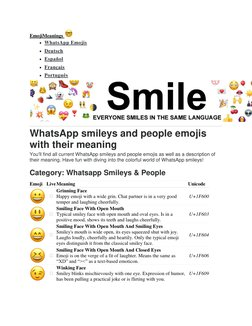
Understanding all emoji meaning can make everyday digital conversations much easier. Emoji are more than colorful pictures placed beside a text message. They can communicate emotions, reactions, humor, affection, sarcasm, agreement, celebration, and even subtle social cues.
The important thing to remember about all emoji meaning is that there is rarely one universal interpretation. Unicode explains that emoji are encoded primarily according to their appearance rather than a single fixed meaning, and their interpretation can change according to culture, language, audience, and context.
What Does All Emoji Meaning Really Mean?
When people search for all emoji meaning, they are usually looking for an easy explanation of what common emojis represent and how people use them in conversations.
For example, 😊 commonly expresses happiness or friendliness, ❤️ can communicate love or strong affection, 😂 usually represents intense laughter, and 👍 often indicates approval or agreement. However, the same emoji can communicate something different depending on the surrounding message.
This is why learning all emoji meaning is not simply about memorizing definitions. Understanding the situation in which an emoji appears is equally important.
All Emoji Meaning for Faces and Emotions
Facial emojis are among the most frequently used symbols in digital communication. They help replace facial expressions and tone that would normally be visible during an in-person conversation.
😀 generally communicates happiness, while 😃 can express cheerful excitement. 😄 often suggests genuine happiness, and 😁 may convey a broad grin or enthusiastic positivity.
😂 is commonly associated with laughing extremely hard, while 🤣 usually represents even stronger laughter. 😅 can indicate nervous laughter, embarrassment, or relief after something stressful.
😊 often feels warm, polite, or affectionate. 🙂 can be a simple smile, although its meaning can sometimes depend heavily on context. 🙃 may communicate irony, awkwardness, or playful frustration.
😢 commonly expresses sadness, while 😭 can represent intense sadness or, in informal online conversations, overwhelming laughter or emotion. 😡 typically represents anger, and 😱 can communicate fear, shock, or surprise.
These examples show why all emoji meaning should always be considered alongside the actual conversation rather than treated as a rigid dictionary.
All Emoji Meaning for Hearts and Love
Heart emojis are especially sensitive to context. ❤️ is widely understood as a symbol of love, affection, care, or emotional support.
💕 and 💕 can suggest affection, closeness, or romantic feelings, while 💖 often conveys excitement or enthusiastic affection. 💔 generally represents heartbreak, sadness, or emotional pain.
Different colored hearts can also carry different associations. 💙 may express trust, friendship, loyalty, or support, while 💚 can represent nature, health, or affection depending on context. 💜 is frequently associated with affection, support, creativity, or particular communities and causes.
Because emotional interpretation varies, all emoji meaning should not be reduced to a single official definition for every colored heart.
All Emoji Meaning for Hands and Gestures
Hand emojis can communicate actions or reactions without requiring words. 👍 commonly indicates approval, agreement, or that something is good. 👎 generally communicates disagreement or disapproval.
👏 is frequently used to show applause, appreciation, or congratulations. 🙌 can express celebration, excitement, gratitude, or enthusiasm.
🙏 is particularly interesting because it can mean different things in different conversations. It may represent prayer, gratitude, pleading, appreciation, or a respectful request.
👋 generally means hello or goodbye, while ✌️ can represent peace, victory, or a casual positive gesture.
These examples demonstrate why all emoji meaning depends partly on cultural and conversational context.
All Emoji Meaning for Objects, Activities, and Symbols
Not every emoji represents an emotion. Many depict everyday objects, places, activities, animals, food, weather, transportation, and symbols.
For example, 🎉 is commonly associated with celebration, 🎂 with birthdays or special occasions, 🎁 with gifts, and 🔥 can describe literal fire or something considered exciting, impressive, or popular.
🚀 may represent a rocket literally, but online it can also suggest rapid growth, ambition, or excitement. 💡 can represent an actual light bulb but is often used to communicate an idea or solution.
This flexibility is one reason all emoji meaning continues to evolve as people create new expressions and combinations.
Why Emoji Meanings Change Over Time
Emoji are not a complete language with fixed grammar and universal definitions. Unicode specifically notes that emoji meanings can change and be repurposed over time.
Social media, messaging platforms, age groups, and different cultures can all influence interpretation. An emoji that seems completely ordinary to one person may carry a humorous, ironic, or unexpected meaning to another.
Platform design can also affect perception. Apple, Google, Microsoft, Samsung, and other platforms may display the same Unicode emoji using different artwork. Unicode does not control the designs used by individual vendors. )
Therefore, searching for all emoji meaning is useful, but context remains the most reliable way to understand what someone intended.
How to Understand Emoji Correctly
The easiest way to interpret an emoji is to read the complete message before deciding what the symbol means.
Consider the sender, relationship, surrounding words, and conversation topic. A 😂 sent after a joke is probably straightforward, while the same emoji after bad news might be used sarcastically or nervously.
It is also helpful to avoid assuming that your interpretation is automatically the sender’s intention. When an emoji seems ambiguous, asking for clarification is usually better than making an assumption.
Frequently Asked Questions About All Emoji Meaning
Do all emojis have one official meaning?
No. Unicode explains that emoji can have multiple meanings depending on language, culture, audience, and context. )
What is the most important thing about all emoji meaning?
Context matters most. The words surrounding an emoji and the relationship between the people communicating can significantly change its interpretation.
Can emoji meanings change over time?
Yes. People can repurpose existing emoji, creating new meanings and cultural associations.
Are emojis a language?
Not by themselves. Unicode explains that emoji do not have the grammar and vocabulary required to constitute a human language. They primarily supplement written communication.
Why does the same emoji look different on different phones?
Different technology companies create their own emoji artwork. Unicode standardizes the underlying characters and sequences but does not control the visual designs used by individual platforms.
Conclusion
Learning all emoji meaning is less about memorizing hundreds of rigid definitions and more about understanding how visual symbols work in modern communication. Faces, hearts, gestures, objects, animals, and symbols can all add emotion and context to ordinary text.
The best approach is to consider the emoji together with the words, situation, culture, and relationship between the people communicating. That makes all emoji meaning much easier to understand and helps prevent misunderstandings in digital conversations.
/dailymagz.com